

Tabi Camping Chair
Snow Peak
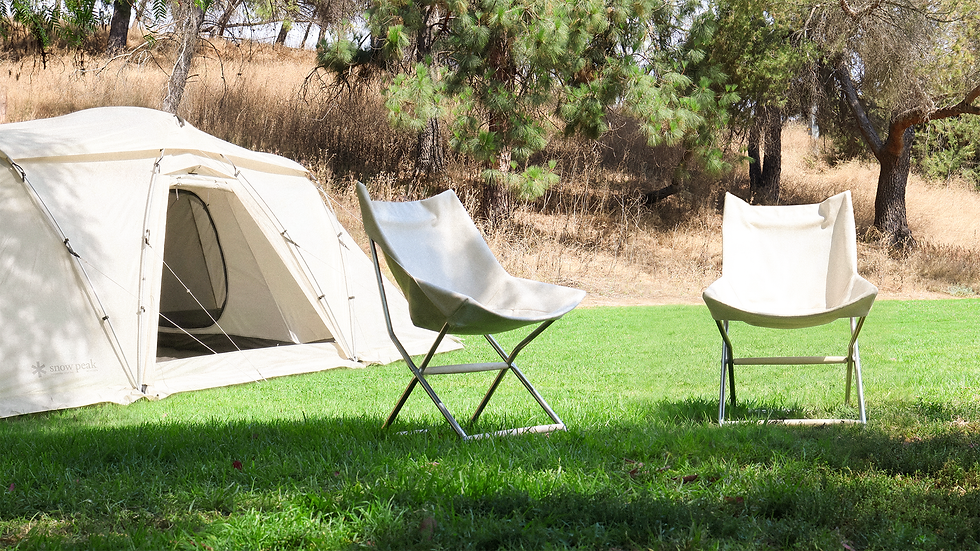
Snow Peak's Take! camping chair reimagined to minimize its environmental impact.
Outdoor Furniture
14 Week Project | 2025
Collaborator: Eunji Ko

click for process details

Camping chair for those who love and care for the world
It's designed with circularity, longevity, and sustainability in mind. Also available as a rentable option at a Snow Peak Campfield location. A more responsible consumer habit.
Clean Natural Beauty

Locally Sourced
All parts are sourced and manufactured locally to reduce environmental impact from international shipping.

Redesigned Frame
The frame bends outwards to offer a more comfortable sitting experience for a wider range of body types.

Thoughtfully Curated Materials
High-wear parts like the feet are made from upcycled bamboo, so they can be easily replaced and composted at little cost to you or the planet.

Undyed Organic Cotton Canvas
The heavyweight seat fabric is undyed to reduce water usage and pollution from dying process.

Easy Maintenance
Simplified mechanism requires no special equipment to maintain and repair. Anyone can do it.


Snow Peak Campfield
Since 2011, Snow Peak has introduced guests to its signature camping experience. Campfield combines carefully selected gear with amenities that highlight the region's unique natural beauty.


How does Tabi fit into Campfield?

Reserve Online
Visitors reserve a Campfield site with all the amenities and gear they need.

Campsite Setup
Employees set up the campsite with the specified gear for the guests

Ease of Travel
Traveling is easy when the need for storing, packing, and traveling with camping gear is removed.

On Arrival
Guests arrive at Campfield with their campsite already set up.

Routine Inspection
After every use, inspection is held regularly to each part to check for quality and damage.

Maintenance and Repair
The chair requires no specialized equipment to perform maintenance or repairs.

Made to Share Designed to Last
Tabi is an addition to their roster of rentable camping gear at Snow Peak Campfield locations.
Its design allows for compact storage, quick setup, and easy maintenance.
Take a look at how we designed Tabi

Our Design Process
Research, inspiration, sketches, prototypes, and final build process.
Copyright protected images, brand neams and logos are property of respective rights holders. The uses shown are for demonstration and eductaional purposes only, and are not actual prodcuts or services of the rights holders.
back to top


Three Benchmark Products
We assessed three different camping chairs. A Dick'sporting goods camping chair, the Nemo Moonlight Elite chair, and the Snow Peak Take! chair.
We tested, disassembled, and analyzed each chair's strengths, shortcomings, and environmental impact.
Testing the Chairs
The basic camping chair is bulky, poorly made, but comfortable.
In our testing, we found that the aluminum frame of Nemo's chair bends significantly under load. This results in the chair squeezing the person sitting in it. Its unique adjustable reclining feature made no difference in comfort.
Snow Peak chair seat size is small and doesn't fit a wide range of body types. They offer repairs for their products, but they must be done at their official repair location in Japan.


Benchmark Product
The snow peak Take! chair was chosen as our focus for a few reasons.
Snow Peak and its products represent quality, clean aesthetics, and sustainable practices.
The target audience is a wider group that appreciates quality, aesthetics, and story. This gives us a wider audience and greater potential to impact our sustainability goals.
Snow Peak is unique in offering a rentable option through its Campfield camping experience. A unique selling point we wanted to leverage.

Life Cycle Analysis
We disassembled the chair into its components and used Sustainable Minds to calculate its environmental impact.
We found that aluminum had the greatest impact on human health from carcinogens during processing.
Following the carcinogens on impact were global warming and ecotoxicity.
1.1 mPts
Total Impact
per functional unit - 10 x 1 year of use
4.4 C02
Total Carbon Footprint
CO2 eq. kg / functional unit
77%
Carcinogenics
Human health impact
12%
total global warming and ecotoxicity
ecological damage
How do we address these issues?
Design Opportunities
Address the problematic materials and manufacturing practices used in the product by using locally sourced, abundant, renewable materials.
Involve circularity and longevity in the design by making it easier to repair, maintain, recycle, and compost.
Resolve the comfort issues with the chair by adjusting proportions and leveraging the material's unique strengths.
Reconsider ownership by promoting responsible consumption through a rental option.


Design Inspiration
We wanted the aesthetic to be inspired by high end fabric chairs.
The function needed to balance performance, practicality, and sustainability.


A chair that champions its materials
We wanted a chair that maximizes its material strengths. It was important to us that the frame be simple and easy to manufacture and still look elegant.


Early Prototypes
We used small-scale models to work out early concepts for the frame and test out paper patterns for the seat.
Once we landed on our concept, we refined it at full scale out of wood and paper.
Digital Problem Solving
The frame was modeled into an assembly in SolidWorks. Two separate models were made: one without a load and another with the frame under a load. The angle of deflection was determined from our observations of aluminum tubing under varying loads.
CLO3D was used to create a digital fabric seat to test our design and create the fabric pattern for the upholsterer.


Small Scale Model
Created a scale model and a technical package to communicate our intent with fit and finish with our upholsterer.
The small scale fabric prototypes validated the digital flat pattern designed in CLO3D.
Full Scale Model
To ensure the chair frame met our specifications, we designed, fabricated, and 3D printed a series of custom jigs that improved the accuracy and consistency of the manufacturing process.
After fabricating enough components to assemble the frame, we conducted a test fit with the prototype fabric seat. This step helped us assess how the fabric interacted with the frame and determine the pattern refinements needed to achieve the desired fit, tension, and drape.


New LCA Comparison
1.1 mPts
Take!
Total Impact
per functional unit - 10 x 1 year use
.27 mPts
Tabi
Total Impact
per functional unit - 10 x 1 year use
4.4 CO2
Take!
Total Carbon Footprint
CO2 eq. kg / functional unit
1.8 CO2
Tabi
Total Carbon Footprint
CO2 eq. kg / functional unit

Copyright-protected images, brand names, and logos are the property of respective rights holders. The above uses are for demonstration and educational purposes only, and are not actual products or services of the rights holders.